A good collection is not enough if the boutique sits in a place that is hard to reach or does not fit the customer profile. The location of a physical shop affects footfall, how often people visit, the way they shop and the cost of running the business. Sometimes a smaller unit on a well-chosen street works better than an impressive space in a place where potential customers only appear occasionally.
When choosing premises it is easy to focus on the rent, the floor area and the look of the window. From a sales point of view, though, a more important question is: are there really people in this location who can buy the clothing on offer?
You look for a place differently for a boutique with youth fashion, differently for a shop with elegant womenswear, and differently again for a unit aimed at customers over 40. The premises should suit not only the entrepreneur’s budget, but above all the sales model.
First define who this boutique is for
The search for premises is best started before viewing any property listings. The first stage should be as precise an answer as possible to the question of who is meant to shop there.
Among the things that matter are:
- the customers’ age
- their lifestyle
- the price level of the clothing on offer
- the type of products
- how often they shop
- how they move around the city
- whether clothes shopping is the purpose of the trip or part of other errands
A boutique with elegant womenswear may need a different setting from a shop based mainly on impulse buying. A customer looking for a dress, a set, a coat or an elegant blouse is often willing to spend more time shopping. She wants to try on several styles, compare cuts and reach a decision calmly.
For this kind of shop, very heavy footfall will not always be the most important criterion. Easy access, somewhere to park, good window visibility and being next to places visited by a similar group of customers can matter more.
Heavy footfall does not automatically mean good sales
One of the more common mistakes in choosing a location is equating a large number of passers-by with high sales potential.
Thousands of people walking past the window do not count for much if most of them are not part of the shop’s target group. From a boutique’s point of view, a place with lower footfall but well matched to the customer profile can be more valuable.
When observing a location, it is good to pay attention not only to the number of people, but also to:
- who moves along the street
- what times footfall is heaviest
- whether people stroll or just pass through quickly
- whether they visit nearby shops and services
- how footfall looks on weekdays versus Saturdays
- whether the area is alive outside office hours too
This kind of observation is best done several times. A street that looks appealing on a Friday afternoon can be almost empty on a Tuesday morning. An area judged only during working hours, in turn, can look completely different on a Saturday, when many customers have more time to shop.
Check what is in the neighbourhood
A boutique’s surroundings affect who shows up in a given place. Neighbouring units can therefore be treated as information about a location’s potential.
For a womenswear shop, it can be an advantage to be near places visited by similar customers. These might include hair and beauty salons, shoe shops, jewellers, cafes and other places tied to shopping and services.
This is not about looking for a street entirely free of competition. The presence of other clothing shops can confirm that customers are used to shopping in that part of the city.
You do have to check, though, whether the profile of those shops is close to your planned boutique. If the whole area is geared towards very cheap clothing, it can be a harder place for a shop offering a more refined, elegant collection.
A location should support the boutique’s positioning, not force the owner to constantly explain why its prices differ from those of neighbouring units.
City centre, mall or residential area?
There is no single type of location that works in every case. Each model has its own advantages and limitations.
A unit on a shopping street
A good street gives strong visibility and lets you build recognition through the window. It is especially attractive when it sits on a natural route your customers take.
Before signing, though, you have to check the actual foot and car traffic. A central address alone does not guarantee sales. Some streets are heavily used, while a parallel street a few dozen metres away can have far less potential.
A city centre or shopping mall
A place like this can provide a steady flow of visitors and access to infrastructure, parking and other shops. The price is usually higher demands on the cost of running the unit and operating within a defined retail setting.
When analysing this kind of location, it is good to look at the customer structure of the whole site, not just the overall number of visitors.
A unit in a residential area
A neighbourhood boutique can work very well if a group of customers matching the shop’s profile lives nearby. In this model, relationships, repeat visits and local recognition matter a great deal.
Easier parking and convenient access can also be an asset. The weaker side is usually a smaller share of passing customers, so the shop has to create its own reason for customers to keep coming back.
Parking and access can matter more than a prestigious address
In womenswear sales, the convenience of a visit has a big influence on the decision to go into a shop. This is especially important in boutiques aimed at customers who drive to do their shopping.
If finding a parking space takes fifteen minutes, some people may give up on the visit before they even reach the door. A similar problem appears when the unit is hard to reach by public transport, or getting there means walking through unintuitive passages.
Before choosing premises, it is worth testing the route yourself:
- by car
- on foot
- by public transport, if it matters in a given city
You also have to look at the shop through the eyes of someone visiting for the first time. Is the entrance visible? Is it clear where to turn? Can the window be spotted from the street? Will a customer arriving by car have time to see the shop and find somewhere to park?
These are simple things, but they are often exactly what decides whether a location is convenient in everyday use.
The window works before the doors even open
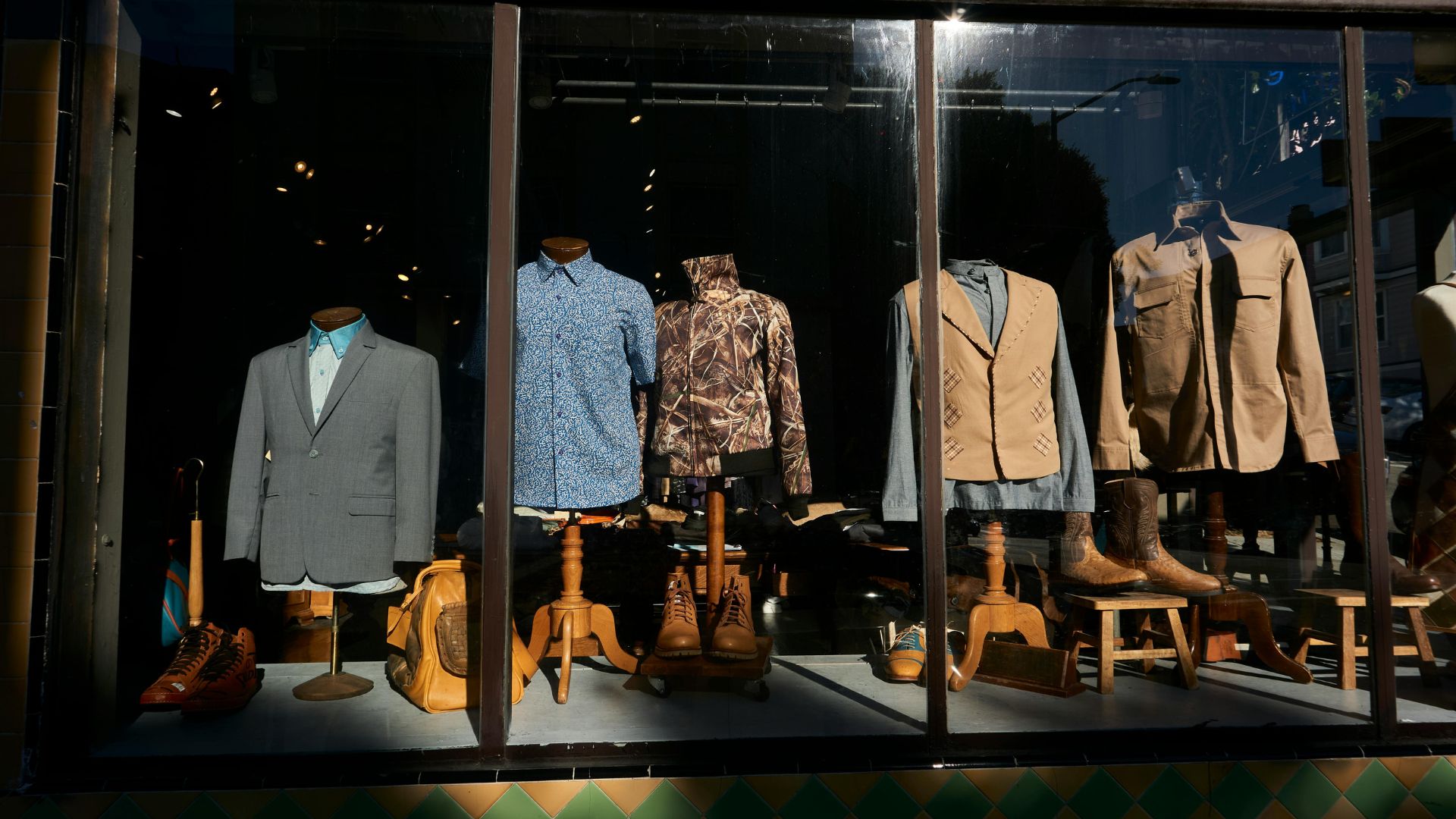
In a clothing boutique, the window is part of the selling. A good display can stop someone who was not planning to shop, or remind a regular customer that a new collection has arrived.
That is why, when assessing premises, you should check:
- the width and visibility of the window
- the distance from the pedestrian route
- the scope for displaying mannequins and the collection well
- the amount of light
- the visibility of the shop signage
- anything blocking the unit from the street
Even a very well fitted-out boutique can lose potential if its window is hidden behind a tree, another company’s advertising or parked cars.
For a shop offering elegant womenswear, the window has an added job: it should immediately communicate the character of the range. Within a few seconds, the customer has to sense whether she is standing in front of a place that matches her style.
Floor area should follow from the way you sell
Larger premises do not always make a better boutique. Every extra square metre generates cost, so the space should match the shop’s real needs.
With clothing, what matters especially are:
- room for a clear display
- comfortable fitting rooms
- space between the rails
- a sales point
- a back room and storage
- the ability to show products without overcrowding
A customer should be able to look at a dress, blouse or coat freely, take the product off the rail and go to the fitting room without squeezing between furniture.
With elegant womenswear, packing the goods in too tightly can also lower the visual value of the collection. A refined cut shows better when it has enough space around it.
Premises have to be assessed together with the planned range
The decision about location should not be separated from the decision about stock. You plan a boutique based mainly on dresses one way, a shop selling complete outfits another, and a place with a collection spanning several categories differently again.
If the offer includes dresses, blouses, tunics, trousers, gilets, sets, overpieces, biker jackets or coats, you need a space that lets you show different product groups without chaos.
The size range matters too. A boutique offering clothing in larger sizes should allow enough room to display the styles and comfortable fitting rooms.
At MAKO we work with boutiques offering elegant womenswear, including collections in sizes 40-54. From our point of view, a well-planned shop makes it far easier to show the cut, the finishing and the way individual pieces of a collection can be combined.
Do not judge a location by the rent alone
Cheap premises can turn out expensive if they do not generate sales. A higher rent, on the other hand, does not automatically mean a bad decision if the place gives access to a well-matched group of customers.
When analysing costs, you have to look wider than the rate per square metre. Additional charges, fitting out the unit, equipment, advertising options, heating costs and the way shared areas are used all matter.
The most important question, though, is: what level of sales does the shop have to make for keeping this place to make economic sense?
Premises should be assessed together with the assumed price level, the margin, the planned stock and the sales potential. Only then can you compare several locations in a business-like way rather than a purely aesthetic one.
A good location supports sales, but it will not replace a good collection
Even the best-located boutique will not keep its customers if the offer is haphazard. A location helps attract the first visit. Whether they return depends on the product, the service and whether the customer finds things in the shop that match her needs.
That is why the choice of place and the choice of supplier should be part of the same plan.
A boutique aimed at women over 40 needs not only the right setting, but also a collection that takes their needs into account. Well-developed cuts, careful finishing, materials and sizes that let you serve real demand all matter.
As a Polish womenswear manufacturer, MAKO works exclusively B2B with physical and online boutiques, wholesalers, distributors and brands. We produce in Poland, work with certified materials and develop the Marguerite by Mako collections with elegant, modern womenswear in mind.
If you are preparing to open a boutique or growing an existing shop and looking for a collection suited to physical sales, get in touch with MAKO. We can talk about our wholesale offer, the available categories and the possibilities for B2B cooperation.