A finished dress on a hanger looks like a single product. In reality, it is the result of many successive decisions: from pattern construction and fit, through fabric selection and cutting, to sewing, finishing and quality control. Each of these stages affects how the garment will look, how it will sit on the body and how it will behave in everyday wear.
For a boutique, wholesaler or clothing brand, the way a dress is produced has a direct business impact. A well-made dress holds its price more easily, gives more predictability with repeat orders and reduces the risk of problems caused by an unrefined cut or poor workmanship.
So what does dress production in a Polish sewing workshop look like, and why does so much happen before the fabric even reaches the sewing machine?
Dress production starts well before the cutting table
Sewing is one of the most visible stages of production, but on its own it does not decide whether a style succeeds. First, you need to define how the dress should look and behave on the body.
At the start, the character of the style is set: its line, length, proportions, type of sleeve and neckline, fastening and any additional details. A simple everyday dress is constructed differently from a more fitted style, and differently again from a style designed for a customer who wants more ease and a fabric that drapes well.
A design may look good on a sketch, but the manufacturer still has to answer much more practical questions: will the style be comfortable, will it keep the right proportions across sizes, and will the chosen fabric achieve the intended effect?
1. Pattern construction – the foundation of a good style
Pattern construction is one of the most important stages in making a dress. This is when the idea is turned into the patterns from which the individual pieces of the garment are later cut.
Pattern construction determines, among other things:
- the proportions of the front and back,
- the shoulder line,
- the width and shape of the sleeve,
- the position of the waist,
- the circumferences,
- the lengths,
- how the dress sits on the body.
A mistake made at this stage will be visible in the finished product, no matter how carefully it is sewn later. The dress may pull under the arms, sit badly across the back, have the waist in the wrong place or simply not allow enough ease.
That is why a good style starts with good pattern construction, not with the sewing itself.
This is particularly important for womenswear in larger sizes. Transferring a style to further sizes requires keeping the right proportions rather than mechanically enlarging every measurement. At Marguerite by Mako, we work with womenswear in sizes 40-54, so fitting the style to real bodies is an important part of our approach to every collection.
2. Choosing the fabric for a specific style
The same pattern made up in two different fabrics can produce a completely different result. A woven or knitted fabric affects how the dress drapes, its shape, its comfort and how the whole product is perceived.
A fabric can be softer or more stable, fluid or able to hold its shape. Its properties need to be taken into account as early as the style development stage.
That is why, in production, fabric should not be treated as something chosen only after the style has been designed. Pattern and material have to work together. For a B2B partner, fabric quality also has commercial significance. When trying on a dress, a customer judges more than its look. She notices the handle, the weight of the fabric, how it drapes and the overall impression of care.
At MAKO, we use certified fabrics. In elegant womenswear, this is one of the elements that builds a consistent product standard.
3. Making up the style and checking the fit
Before production of a larger quantity begins, the pattern has to be turned into an actual garment.
Only then can you assess things that cannot be fully predicted on a flat pattern. Checks include how the dress sits on the body, whether its proportions are right and whether individual construction details work as intended.
This is the stage where corrections may be made. Sometimes a small change to the pattern decides whether a garment looks average or genuinely good. The manufacturer therefore has to do more than create an attractive style: it has to bring it to a form that can be produced consistently.
4. Pattern grading – one style, different figures
Once the style has been refined, the further sizes are prepared. This process is known as pattern grading. It is a particularly important moment for a manufacturer whose collections are aimed at women wearing sizes 40-54. The individual elements of the style have to change in the right proportions.
Poorly done grading can mean a style fits well in one size but much worse in the next. The boutique then has a harder time selling and a less predictable size range. That is why, when choosing a clothing supplier, it is worth looking beyond a single sample. A good size range should be built into the construction of the whole collection.
5. Cutting – when the pattern meets the fabric
Once the patterns are ready, cutting can begin. The individual parts of the dress are cut from the fabric according to the finished pattern.
Precision matters a great deal here. If a piece is cut incorrectly, the problem carries over into the following stages. A seamstress can join the parts very carefully, but she cannot correct a badly cut piece that way.
This shows clearly that the quality of a finished dress is built step by step. Product control does not start only after sewing is finished. Every earlier stage affects the final result.
6. Sewing the dress – precise workmanship matters
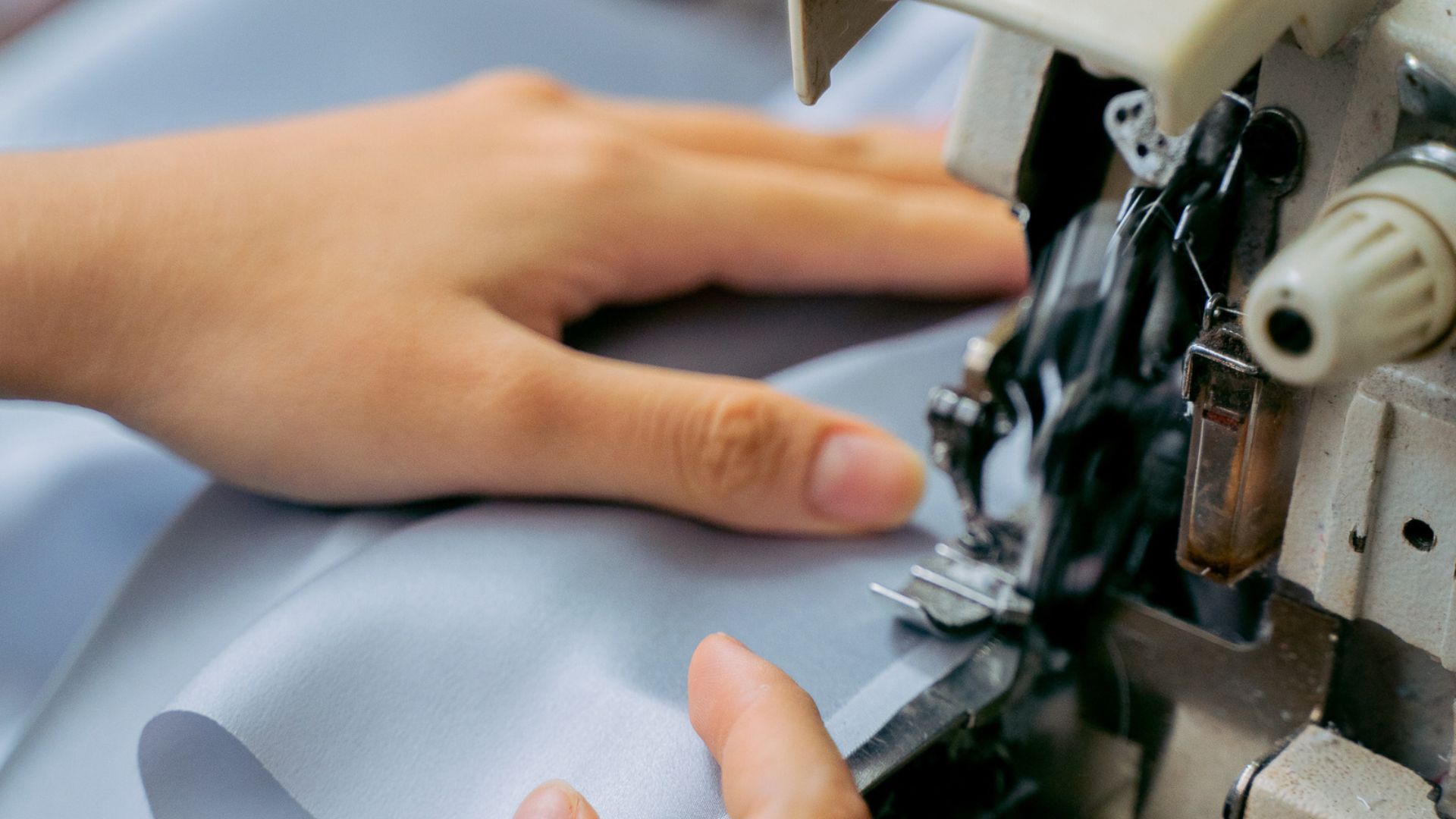
Only now do the pieces cut from the fabric start to become a dress. The individual parts are joined according to the technique specified for that style.
The scope of work naturally depends on the construction. A simple style with few pieces is sewn differently from a dress with sleeves, a fastening, additional topstitching or more elaborate finishing. This is where the experience of the production team really shows. What counts is accurate seams, correct joining of the pieces and consistency from one garment to the next.
For the end customer, these are often details she doesn’t consciously analyse. But she does notice the effect. The dress looks neat, sits properly and gives the impression of a well-made product. For a boutique, this is a strong argument in conversation with a customer: the product is easier to defend on quality when selling.
7. Finishing – the stage that sets a refined product apart from an average one
Once the main parts have been sewn together, the work on the dress is not over. There is still the finishing, which depends on the particular style. This is where a manufacturer’s approach to quality is most visible. Inaccuracies in finishing can weaken the impression made by even an attractively designed style.
What matters includes even seams, the neatness of individual details and how the whole garment looks once the work is done. In elegant womenswear, such details matter a great deal. A customer buying a dress does not judge pattern construction, cutting and sewing separately. She sees one finished product. If every earlier stage has been done well, the end result is coherent.
8. Dress quality control – the final stage or a process that runs through all of production?
Quality control is most often associated with a final check of finished garments. In good production, however, it should begin much earlier. Quality is built during:
- pattern construction,
- fabric selection,
- checking the sample,
- size grading,
- cutting,
- sewing,
- finishing.
At the end, the finished dress can be assessed as a whole. This is when the workmanship and appearance of the product are checked, along with whether it meets the agreed standard.
For a B2B buyer, it is consistent quality that is one of the most important results of well-organised production. A boutique needs to be sure that every piece of the same style is made to a similar standard.
Why does in-house production in Poland matter to a B2B partner?
For a boutique or brand, where a garment is sewn is not just a line of information on the product. Having its own production facility gives a manufacturer more influence over each stage of creating a collection.
MAKO is a Polish womenswear manufacturer, and our production takes place in Poland. We combine tailoring experience with modern design and develop our collections with B2B cooperation in mind. Business partners deal with a company that is responsible for the product it makes, not only for distributing it.
This matters to:
- bricks-and-mortar boutiques,
- online shops,
- wholesalers and distributors,
- clothing brands,
- designers,
- companies looking for a manufacturing partner.
In-house production also makes it possible to develop the partnership and take on new orders when there is a need to go beyond the current range.
A good dress is the sum of many well-executed stages
When looking at a finished collection, it is easy to judge mainly the print, colour or price. Yet just as much happens at the stages a boutique never sees.
A well-made dress needs considered pattern construction, the right fabric, accurate size grading, precise cutting, careful sewing and refined finishing. Only the sum of these elements produces a garment that looks good not just in a photo, but above all on the customer.
That is why, when choosing a womenswear manufacturer for your boutique, it is worth asking about more than the price of the finished style. It also helps to know where the clothing is made, what fabrics the manufacturer works with, how it approaches fit and whether it is responsible for its own production.
At MAKO, we produce elegant womenswear under the Marguerite by Mako brand in Poland, working with certified fabrics and developing collections in sizes 40-54. We operate exclusively on a B2B basis, working with boutiques, wholesalers, distributors, brands and companies in Poland and across Europe.
If you are looking for a Polish womenswear manufacturer, want to see our wholesale offer or would like to discuss a new production order, get in touch with MAKO. We can talk through the scope of cooperation and work out which model best suits your business.